Is That Ring Platinum or White Gold? How to Tell in 30 Seconds
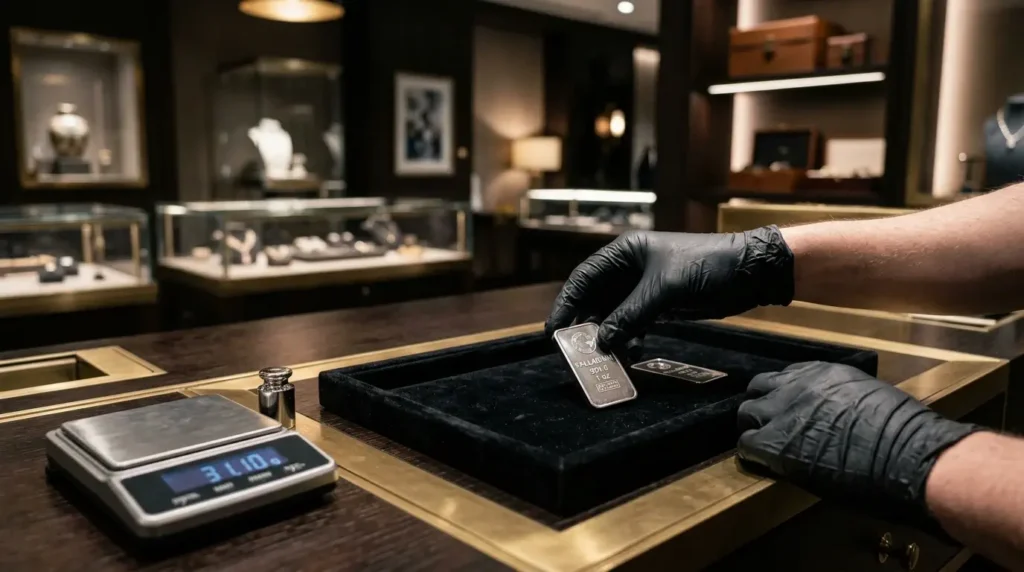
Platinum Buyers · Houston, TX Platinum Buyer in Houston: Is That Ring Platinum or White Gold? How to Tell in 30 Seconds They look identical in a jewelry box. One contains roughly 95% precious metal, the other about 58%. Here is how to spot the difference before you sell. The most common conversation a platinum buyer in Houston has starts with somebody sliding a plain white band across the counter and saying “I think this is white gold.” Roughly a third of the time, it isn’t. Platinum and white gold are nearly impossible to tell apart by eye, which is exactly why platinum gets undersold, traded in, or left in a drawer for decades. The good news is that the difference is easy to confirm yourself with a magnifying glass and your own two hands, and it matters a great deal, because a platinum ring typically contains around 95% pure precious metal while a 14k white gold ring contains about 58%. Quick Answer Platinum is stamped PLAT, PT950, PT900, or IRIDPLAT, feels noticeably heavier than a white gold ring of the same size, and stays white forever. White gold is stamped 14k, 18k, 585, or 750, weighs less, and is rhodium plated, so it slowly turns warm and yellowish at the back of the band as the plating wears. Platinum is usually 90% to 95% pure, which is why it is bought and paid for by weight and purity like any other precious metal. The 30-Second Test Four Ways to Tell Platinum From White Gold Without a Jeweler 1. Read the stamp. Look inside the band with a magnifying glass. Platinum says so: PLAT, PT, PT950, 950, PT900, or on older American rings, IRIDPLAT or 10% IRID PLAT. White gold uses karat marks instead: 14k, 585, 18k, 750. 2. Feel the weight. This is the test people trust once they try it. Platinum is one of the densest metals used in jewelry, considerably denser than gold alloys. Put a platinum band in one hand and a white gold band in the other and the platinum feels obviously, almost surprisingly heavy for its size. 3. Look at the back of the band. White gold is plated with rhodium to make it bright white. That plating wears off with daily contact, so a worn white gold ring shows a faint warm, yellowish or grey cast underneath, usually first on the underside. Platinum has no plating to lose. 4. Check the surface texture. Old platinum does not lose metal when it scratches, it displaces it, developing a soft satin finish jewelers call a patina. Old white gold looks dull and slightly yellow instead. Reference Chart What Every Platinum Stamp Means Platinum purity is written in parts per thousand, the same system used for silver. Anything at 850 or above is sold and taxed as platinum in the United States. Stamp Composition Where You See It PT999 / 999 PLAT 99.9% platinum Bullion bars and coins PLAT / PT950 / 950 95% platinum The US jewelry standard, most rings PT900 / 900 PLAT 90% platinum Common in Japanese and older pieces PT850 / 850 85% platinum Chains and lighter-weight jewelry IRIDPLAT / 10% IRID PLAT 90% platinum, 10% iridium American rings from roughly 1900 to 1950 PD500 / PD950 Palladium, not platinum 2000s wedding bands, still valuable 14k / 585 / 18k / 750 White gold Rhodium plated gold alloy WG, “White Gold” Gold alloy Not platinum, priced as gold If you find an IRIDPLAT stamp, pay attention. That mark dates a piece to the first half of the twentieth century, the height of the Art Deco era, when platinum was the metal of choice for fine engagement rings. Those pieces sometimes carry design and period value on top of their metal weight, so they deserve a proper look rather than a scrap-only quote. “A platinum ring does not wear away, it wears in. Every scratch it has collected is still there in the metal, and it all still weighs on the scale.” Why Platinum Is Different Rarer Than Gold, and Priced by a Market Most People Never See Annual global platinum production is a small fraction of annual gold production, and the supply is concentrated in a handful of countries, with South Africa accounting for the large majority. The USGS platinum-group metals statistics track how tight that supply chain really is. Here is the part that trips up sellers: scarcity does not automatically mean a higher price than gold. Platinum is an industrial metal as much as a jewelry metal, with heavy demand from automotive catalytic converters, chemical refining, and laboratory equipment, so its price responds to manufacturing cycles in ways gold does not. Platinum has traded both above and below gold at different points in recent history. Benchmark prices are set through the daily precious metal price auctions, and they move every day. What that means practically: do not assume your platinum is worth less than gold, and do not assume it is worth more. Have it weighed and priced on the day you sell. At the Counter How a Platinum Appraisal Actually Works in Houston The acid tests that work on gold are unreliable on platinum, because platinum resists almost every acid you can throw at it. That is why a serious buyer reaches for electronic or XRF analysis instead, which reads the actual composition of the alloy without cutting, filing, or damaging your piece. From there it is straightforward. The item goes on a certified scale, the purity from the test is applied, and the day’s market rate does the rest. If your piece holds diamonds or colored stones, those get evaluated separately and added on top, since the setting and the stones are two different kinds of value in the same object. Every step of that should happen where you can see it. Weight read out loud, purity stated, math shown. Anything less and you have no way to check the number you are being handed. See Exactly