
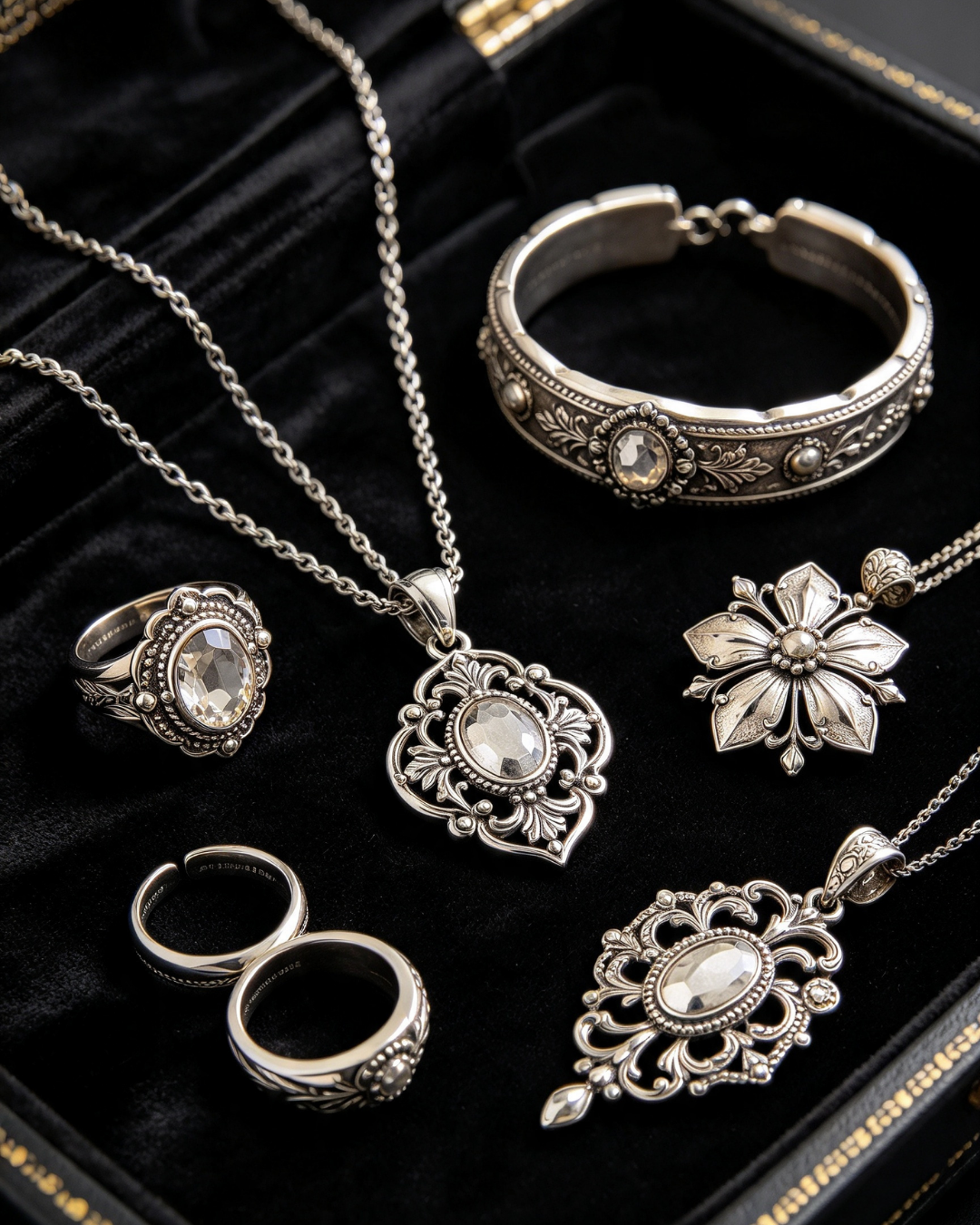
How to Identify Antique Silver Jewelry: Hallmarks, Age, and Value
Tiny stamps, old clasps, and a few telling details can date a piece, confirm it is real, and reveal whether it is worth far more than its silver.
Knowing how to identify antique silver jewelry is the difference between selling a family locket for its weight and selling it for what it is actually worth. Most old silver arrives at our Heights counter in a jewelry box nobody has opened in years: tarnished bracelets, a brooch with a bent pin, a ring with marks too small to read. The good news is that antique silver usually tells you its own story. You just need to know where to look, which marks matter, and which ones mean there is no silver at all.
To identify antique silver jewelry, look for hallmarks on the clasp, pin, or inside of the piece, then use them to find the silver purity, country, and sometimes the maker and year. Sterling, 925, a lion passant, or a Mexican eagle mark point to real silver, while German silver, nickel silver, Alpaca, and EP do not. Style and clasp type help date unmarked pieces, and a known maker, period, or natural stones can make a piece worth more than its melt value.
Where to Find Hallmarks on Antique Silver Jewelry
Marks hide in predictable places: on the tongue of a box clasp, beside the jump ring on a necklace, on the back of a brooch near the pin, inside a bangle or ring shank, and on the bail of a pendant or locket. Use a 10x loupe and good light, and tilt the piece so the stamp throws a shadow.
British silver is the easiest to read, because a full hallmark is a row of punches for the maker, the silver standard, the assay town, and the year. The London Assay Office traces this system back to 1300, when English silver first had to be tested before it could be sold.
Antique Silver Hallmarks by Country
Once you find a mark, this quick guide tells you where the piece likely came from and how much silver it holds.
| Country | Mark | What it tells you |
|---|---|---|
| United States | Sterling, 925 | 92.5% silver, common on American pieces from the mid 1800s on |
| United States | Coin, Pure Coin, Standard | About 90% silver, mostly before the 1860s |
| Britain | Lion passant + town mark + date letter | Sterling, with the assay city and exact year |
| Britain | Sovereign's head | Duty paid mark, dates the piece between 1784 and 1890 |
| France | Minerva head | Standard silver mark used since 1838 |
| Germany | 800 + crescent and crown | 80% silver, from 1888 on |
| Scandinavia | 830, 830S, 925S | 83% or 92.5% silver, common on Danish and Norwegian work |
| Mexico | Eagle with a number, or TS / TA code | Eagle marks 1948 to 1980, letter codes after; the number or code identifies the workshop |
| Anywhere | German silver, Nickel silver, Alpaca, EP | No silver, or only a thin plated layer |
In the US, the FTC Guides for the Jewelry Industry require at least 92.5% silver for anything sold as sterling today, but older and imported pieces follow their own country's standards.
"Tarnish is not damage. On old silver, it is often the first proof of age."
How to Date Unmarked Antique Silver Jewelry
No marks? Style and hardware still narrow it down. Georgian and early Victorian brooches often use a simple C clasp with no safety catch. Screw back earrings appear around the turn of the twentieth century, and clip backs take over in the 1930s. Hand soldered links, slight irregularities, and hand cut stones point to older work than perfectly uniform machine made pieces.
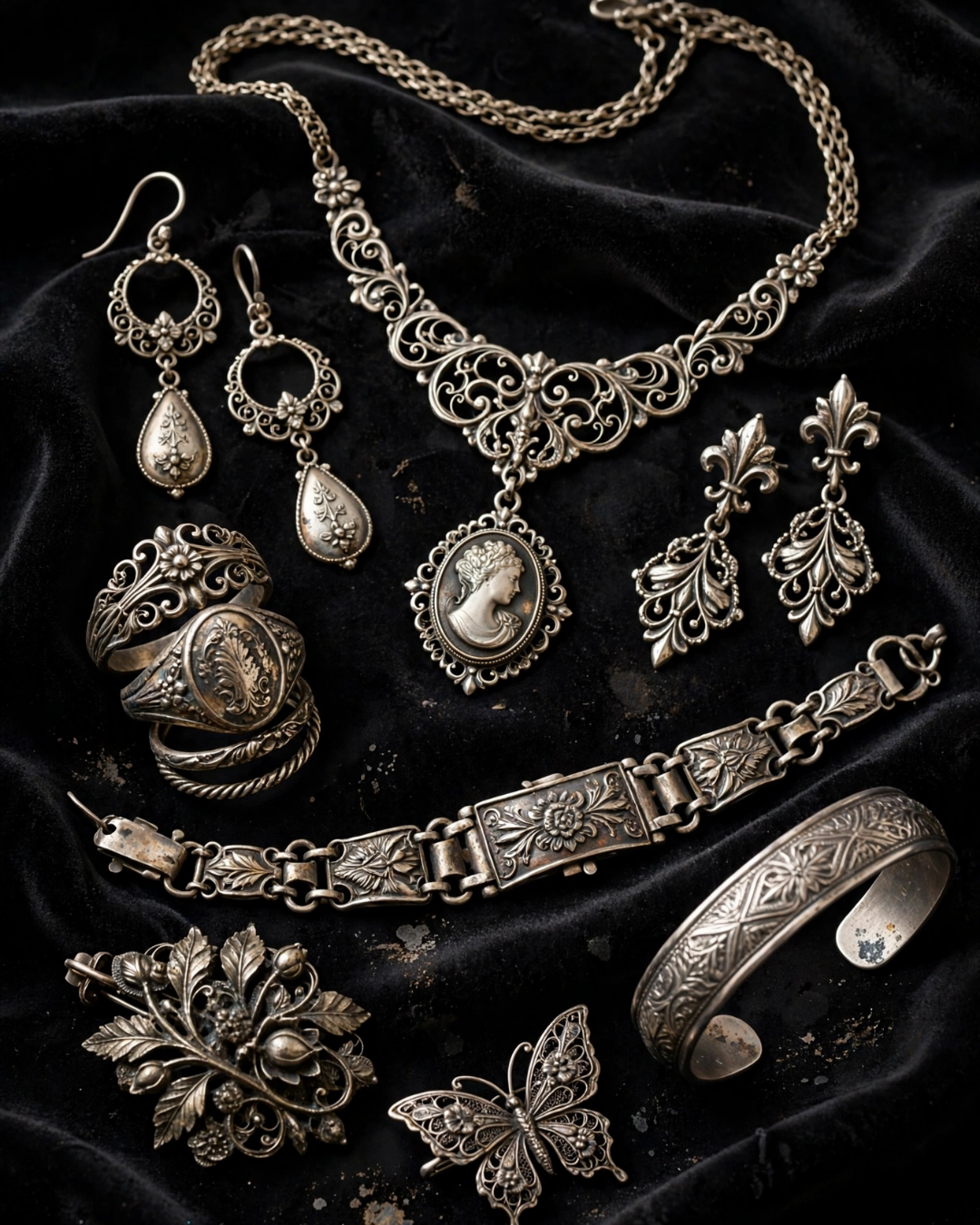
Design helps too. Flowing plant forms and women's profiles suggest Art Nouveau, around 1890 to 1910. Bold geometry and marcasite point to Art Deco in the 1920s and 1930s. Heavy, sculptural silver with pre-Columbian motifs is a hallmark of mid century Taxco.
How to Tell If Silver Jewelry Is Real
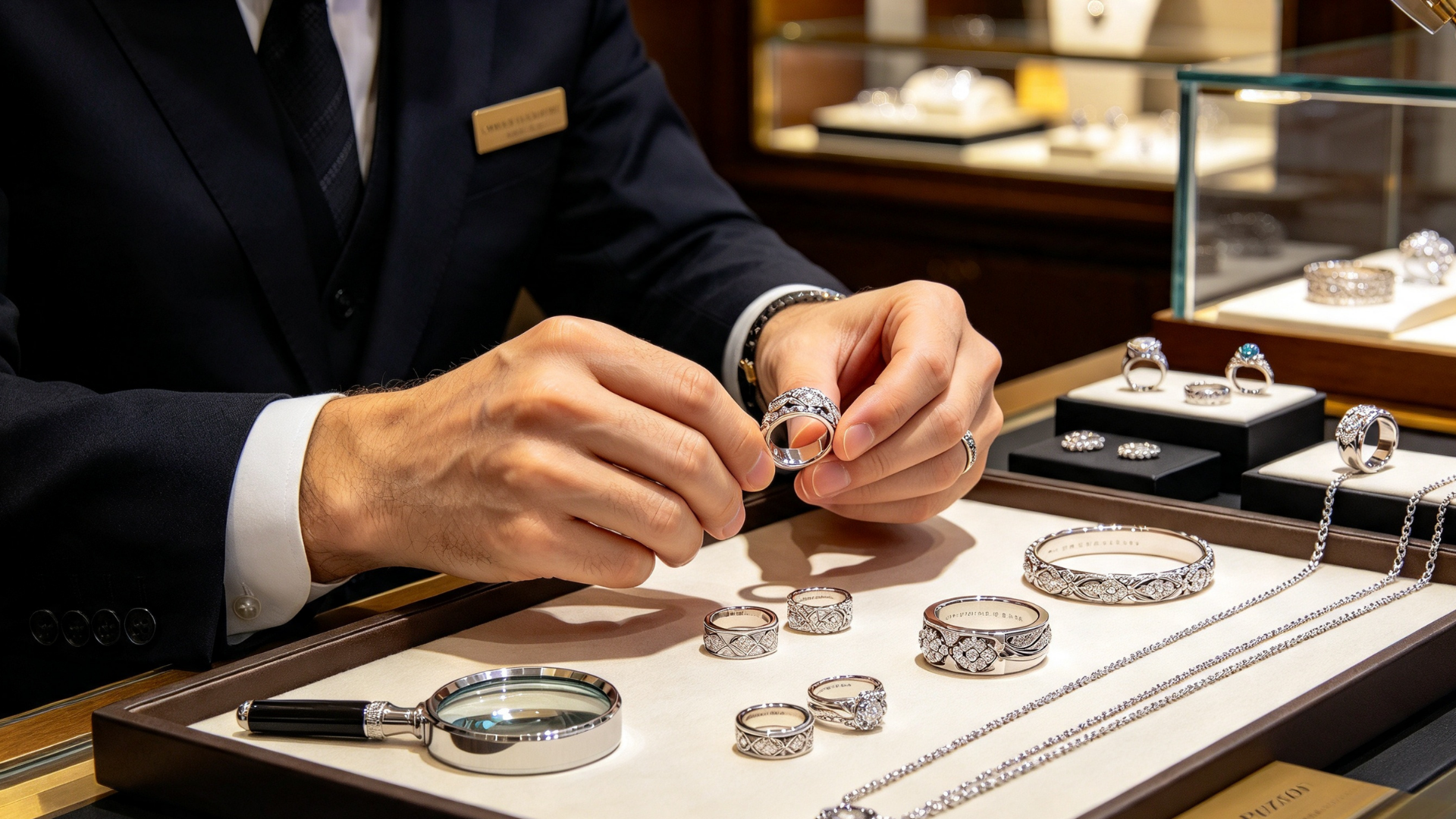
The most common surprise at our counter is German silver. Despite the name, it is a copper, nickel, and zinc alloy with no silver in it, and it was widely used for costume jewelry and souvenirs. The same goes for nickel silver and Alpaca. Silver plate marked EP or EPNS has only a thin coating over base metal.
A magnet test helps a little: real silver is not magnetic, so a piece that grabs a magnet is not solid silver. But brass and copper are not magnetic either, so passing the test proves nothing. Some nineteenth century American makers also used pseudo hallmarks that imitate British marks, so a lion is not always a British lion. When in doubt, a non destructive metal test settles it.
Want an Expert to Read Your Marks?
See how we value antique silver for maker and age, not just weight, and what to bring to your free appraisal.
Visit Our Antique Silver Jewelry Buyer Page Get an AppraisalDid You Know? Five Curious Facts About Antique Silver
The tiny marks on your jewelry carry centuries of history.
Where the Word Hallmark Comes From
Silver was tested and stamped at Goldsmiths' Hall in London, so the stamp itself became known as a hall mark.
The Lion Has Walked Since 1544
The lion passant was added to English silver in 1544 and still marks British sterling today.
A Tax You Can Still See
From 1784 to 1890, British silver carried a small portrait of the reigning monarch to show that duty had been paid.
Taxco Was Reborn in the 1930s
American designer William Spratling opened a workshop in Taxco in the early 1930s and helped turn the town into Mexico's silver capital.
France Marks Silver With a Goddess
Since 1838, French sterling has carried a tiny head of Minerva, the Roman goddess, as its standard mark.
5 Ways to Protect the Value of Vintage Silver Jewelry
Simple habits that keep collector value intact until the appraisal.
Use a Loupe, Not a Polish Cloth
A 10x jeweler's loupe reads worn marks far better than polishing ever will, and it does not remove anything.
Photograph Every Mark
Take close ups of each stamp before you visit. Photos make research, and an online quote, much faster.
Keep Pieces Together
Pairs, parures, and matching sets are worth more whole. Keep them in the same bag or box.
Save the Story
Who owned it, where it came from, and roughly when. Provenance can help place a piece in time.
Get Both Numbers
Ask any buyer for the melt value and the collector value, and why they differ. A fair buyer will explain both.
Found the Marks? Find Out What Your Antique Silver Is Worth
At Houston Cash For Gold, 1801 Durham Drive Suite 9 in the Heights, we read hallmarks, identify makers and periods, and test and weigh every piece in front of you. You get one offer that covers both the silver and any collector value, paid the same day if you accept. Holding modern sterling too? We also buy silver jewelry of every age, and there are more guides on our blog.
How to Identify Antique Silver Jewelry: FAQ
The questions Houston sellers ask us most about old silver.
Start with the marks: Sterling, 925, a British lion passant, 800 with a crescent and crown, 830S, or a Mexican eagle mark all point to real silver. Words like German silver, nickel silver, Alpaca, or EP mean little or no silver. Many old handmade pieces carry no mark at all, so the only sure answer is a metal test, which a buyer can do in front of you without damaging the piece.
A full British hallmark is a row of small punches: a maker's mark, a standard mark such as the lion passant for sterling, a town mark such as the leopard's head for London, the anchor for Birmingham, or the crown for Sheffield, and a date letter for the year of assay. Pieces from 1784 to 1890 may also show the sovereign's head duty mark. Together they can date a piece to a single year.
In the trade, antique usually means 100 years old or more, and vintage covers pieces roughly 20 to 99 years old. Both can be worth more than their silver content if the maker, style, or condition is desirable to collectors.
Sometimes. The silver itself is worth the same by weight, but antique pieces can add collector value for the maker, period, craftsmanship, and stones. A signed Taxco bracelet or a Victorian locket with crisp hallmarks can sell well above melt, while a worn, unmarked bangle may sell close to its silver value.
No. Polishing wears down hallmarks and removes the patina collectors look for, and dips or ultrasonic cleaners can damage turquoise, pearls, and old settings. A gentle wipe with a soft dry cloth is the most you should do before an appraisal.
The biggest value drivers are a known maker or signature, a desirable period such as Georgian, Victorian, Art Nouveau, or early Taxco, strong craftsmanship, natural stones like turquoise or garnet, and good condition with readable marks. Complete sets and original boxes help too.
Houston Cash For Gold buys antique and vintage silver jewelry at 1801 Durham Drive Suite 9 in the Heights. We read the hallmarks, identify the maker and period, test and weigh each piece in front of you, and pay the same day if you accept the offer. Walk-ins are welcome. Call (832) 295-9155.
Get a Free Antique Silver Appraisal Today
Bring your lockets, bracelets, brooches, and estate pieces and walk out with a same-day cash offer. No appointment, no pressure, and no obligation to sell.
Call (832) 295-9155 or visit 1801 Durham Drive Suite 9, Houston, TX 77007.